블로그

Carbon Molecular Sieve Nitrogen Generation Principle: Core Technical Analysis of PSA Air Separation

Carbon Molecular Sieve Nitrogen Generation Principle: Core Technical Analysis of PSA Air Separation

June 18, 2026

1. Core Basics: What is Carbon Molecular Sieve (CMS)

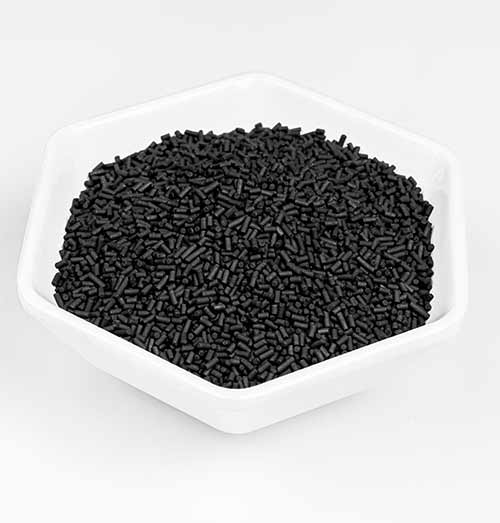
  Carbon Molecular Sieve (CMS) is a porous carbon adsorption material and the core consumable for PSA nitrogen generators. It features uniformly distributed nano-scale micropores, precisely controlled at 0.28–0.30nm – falling right between the kinetic diameters of oxygen (0.28nm) and nitrogen (0.30nm) molecules, which provides the precise physical foundation for air separation.


2. Core Principle of Kinetic Adsorption Separation

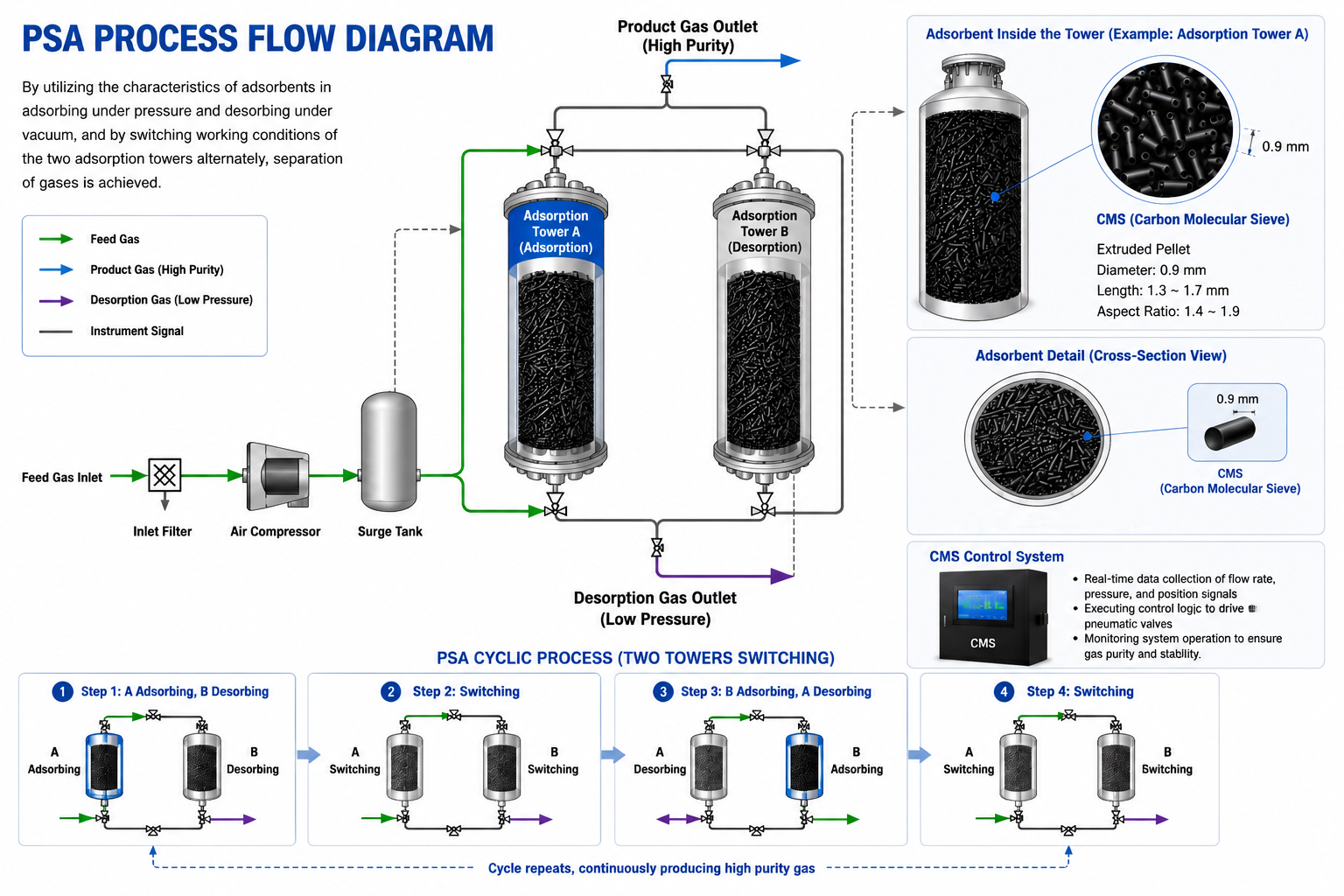
  CMS-based nitrogen production relies on differences in molecular diffusion rates, rather than physical sieving. After purification, compressed air enters the CMS-filled adsorption tower. Oxygen molecules, being smaller, diffuse faster and are rapidly adsorbed into the micropores. Nitrogen molecules, slightly larger and slower, pass through the bed within the set cycle to yield high-purity nitrogen. This process depends on diffusion time differences, defining it as kinetic separation. Once the micropores are saturated with oxygen, the system depressurizes to desorb and discharge the trapped oxygen, allowing the CMS to regenerate automatically – without heating or chemical agents – for long-term cyclic service.


3. Complete Process Flow of PSA Pressure Swing Adsorption Nitrogen Generation

  Carbon molecular sieve cannot work independently. It needs to match a dual-tower PSA system to realize continuous nitrogen supply through alternating pressurized adsorption and decompression desorption. The complete nitrogen generation process is divided into four key procedures.

  3.1 Air Pre-treatment System (Pre-purification)

  The air compressor compresses atmospheric air to 0.6-0.8MPa. Then the compressed air passes through refrigerated dryers and three-stage precision filters to completely eliminate dust, liquid water and oil contamination. Moisture and oil are the top threats to carbon molecular sieves, which will cause irreversible micropore blockage, damage adsorption performance permanently and shorten the service life of CMS dramatically. Therefore, a complete pre-filter system is indispensable for standard PSA nitrogen generators.

  3.2 Pressurized Adsorption (Core Nitrogen Production Stage)

  Purified dry compressed air flows into the CMS-filled adsorption tower. Under high pressure, oxygen molecules are quickly adsorbed into micropores, while nitrogen molecules pass through the tower directly. High-purity nitrogen with a purity ranging from 95% to 99.999% can be produced within dozens of seconds.

  3.3 Pressure Equalization (Energy-saving & Protection Process)

  After one adsorption tower reaches oxygen adsorption saturation, the system switches automatically and balances pressure between dual towers. Residual pressure inside the tower is recycled to reduce energy consumption for subsequent pressurization. Meanwhile, this process avoids sharp pressure fluctuation to prevent CMS particle pulverization, effectively extending the service life of carbon molecular sieves.

  3.4 Decompression Desorption (Molecular Sieve Regeneration)

  The saturated adsorption tower is depressurized to atmospheric pressure rapidly. Oxygen and other impurity gases trapped in micropores are fully desorbed and exhausted. The micropores of CMS return to vacant state to finish automatic regeneration. No extra heating device or consumable replacement is required during the whole regeneration process.


4. Performance Comparison: PSA CMS Nitrogen Generation vs Other Nitrogen Production Technologies


Nitrogen Generation Method

Start-up Time

Operating Cost

Applicable Scenarios

Max Nitrogen Purity

PSA CMS Nitrogen Generation

3-5 minutes for qualified nitrogen output

Low, no frequent consumable replacement

Most medium and small industrial sites

99.999%

Cryogenic Air Separation

More than 8 hours pre-cooling time

Extremely high, high equipment investment & power consumption

Large-scale centralized high-flow nitrogen supply

99.9995%

Membrane Separation Nitrogen Generation

Instant gas output

Medium, membrane modules prone to aging

Large-flow demand with low nitrogen purity requirement

99.5%


  Considering overall cost performance, flexible start-stop performance and maintenance difficulty, PSA CMS nitrogen generation has become the preferred solution for over 90% of medium and small industrial nitrogen supply projects worldwide.


5. Influence of CMS Quality on Nitrogen Generator Performance

  More than 70% of the overall performance of PSA nitrogen generators depends on the quality of carbon molecular sieves. There is a huge performance gap between low-end inferior CMS and industrial high-precision CMS:

  • Inferior Carbon Molecular Sieve: Uneven micropore distribution, poor compression resistance and low oxygen adsorption capacity. It will lead to substandard nitrogen purity, insufficient gas output and increased power consumption, requiring overall replacement within 1-2 years;
  • Our High-precision Carbon Molecular Sieve: Features uniform micropore distribution, high mechanical strength, large oxygen adsorption capacity and excellent oil & moisture resistance. Compatible with full-series PSA nitrogen generators, our CMS boasts a service life of 6-8 years under standard working conditions. Stable long-term gas production effectively cuts power consumption and daily maintenance costs for end users.


6. Our Product Portfolio: One-stop Supply of Full-range Air Separation Adsorbents

  With more than 10 years of professional experience in air separation adsorption material industry, our company focuses on the R&D, production and sales of molecular sieves and supporting air separation consumables. Our main product lines cover:

  • Full-series industrial nitrogen generation CMS (CMS 220/240/260/280)
  • Lithium molecular sieve & zeolite molecular sieve for PSA oxygen generators
  • Activated alumina and silica gel desiccants for air drying systems
  • Customized air separation tower fillers and integrated air separation solution services

  We support sample trial orders, bulk stock wholesale and customized pore size production. Free technical services including molecular sieve selection guidance and nitrogen generator commissioning support are available. We help nitrogen equipment manufacturers and end industrial users improve gas production efficiency and reduce overall gas supply costs.


7. Frequently Asked Questions

  •       Q: Is regular replacement of carbon molecular sieve required?
  • A: Frequent replacement is not needed under standard working conditions. With well-functioning pre-purification systems, our carbon molecular sieve can serve stably for more than 6 years. Only regular inspection of air compressors and precision filters is required.    


  •       Q: Can nitrogen purity be adjusted freely?
  • A: Yes. The nitrogen purity can be adjusted from 95% to 99.999% flexibly by changing adsorption time and working pressure, meeting the nitrogen demand of food packaging, electronic welding, chemical industry and other fields.


  •       Q: Will low ambient temperature affect nitrogen generation efficiency?
  • A: Our PSA nitrogen system works stably within 0-45. For outdoor low-temperature working scenarios in cold regions, matched thermal insulation components can ensure stable continuous gas production. 


Qianjiang Industrial Zone, Guichi district chizhou city, Anhui province, China
빠른 링크
구독하다

계속 읽어주시고, 최신 소식을 받아보시고, 구독해주세요. 여러분의 의견을 들려주시면 감사하겠습니다.

제출하다
f

저작권 @ 2026 Chizhou Shanli Molecular Sieve Co., Ltd. 모든 권리 보유. 네트워크 지원

블로그 사이트맵 Xml 개인정보 보호정책

메시지를 남겨주세요

메시지를 남겨주세요
저희 제품에 관심이 있으시고 자세한 내용을 알고 싶으시다면, 여기에 메시지를 남겨주세요. 최대한 빨리 답변해 드리겠습니다.
제출하다

제품

문의하기

Start a Conversation

Hi! Click one of our members below to chat on